| s/y Nine of Cups Central Vanuatu Islands Efate, Epi, Ambrym, Malekula & Espiritu Santo Islands - October 2011 |
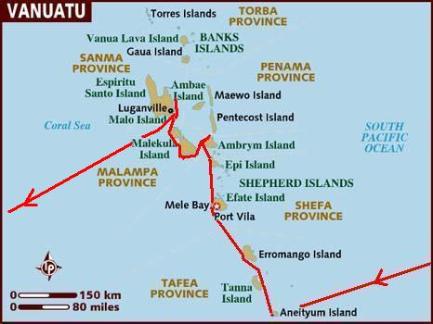
| All too soon, it was time to leave Vanuatu and head to Australia for cyclone season. We missed visiting many areas that were on the planned itinerary, but what we did see and experience was fantastic. We headed back to Luganville for re-provisioning, duty-free diesel and final check-out and we were off. Come with us to Chesterfield Reef en route to Australia where we begin our adventures in a new country and a new continent! Remember there's always an adventure Sailing with Nine of Cups. |
| Port Vila, Efate Island - 17S44.88 / 168.18.63 - Moored |
| The trip from Erromango to Vanuatu's capital city of Port Vila on Efate Island was 84 nm and an overnight passage. We left Dillon's Bay late afternoon and arrived in Port Vila midday. Port Vila, or just Vila as the locals call it, is situated at the head of a horseshoe bay. James Cook originally surveyed the area and named it after his patron, Lord Sandwich, but the islanders' own name for it, Efate, has prevailed. With a population of about 46,000, it's one of the South Pacific's largest and most attractive towns. We were looking forward to well-stocked supermarkets, fresh market fruits and veggies and showers...oh yeah, and internet! |
| We picked up a mooring in the calm, deep waters right off the downtown area of Port Vila. The town is living up to expectation. Port Vila is busy and bustling and seems to have about everything we'd need or want. The French influence here is seen in the fresh baguettes for 60 cents each and a grand supermarket, Au Bon Marche, which is well-stocked, tidy and has so much variety we're nearly overwhelmed. People are friendly...drivers even stop for pedestrians. As wonderful as it is, we need to provision, do some chores and get moving as quickly as possible in just a few days so we can head north through the rest of these enchanting islands before it's time to head to Australia for the cyclone season. No lingering allowed. |
| Cups in the foreground moored off Port Vila |
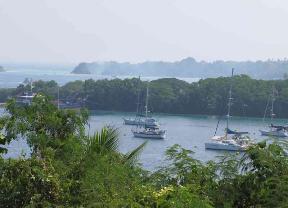
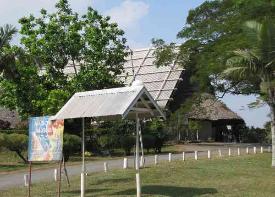
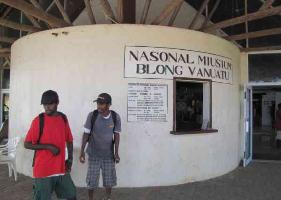
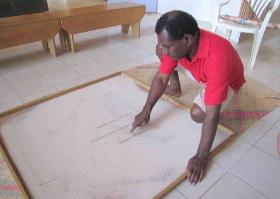
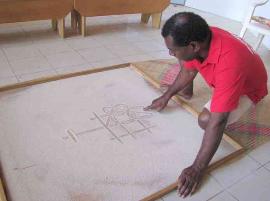
| As we set about exploring the town, the Vanuatu National Museum was a priority. |
| Nasonal Miusium Blong Vanuatu...Bislama for Vanuatu National Museum was 700 vt/ea |
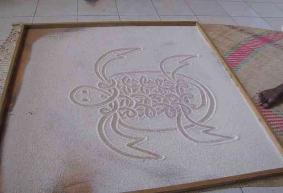
| One of the most interesting art forms in the northern islands is sandroing (sand drawing). It provides a method of illustrating local legends and telling stories with elaborate designs. |
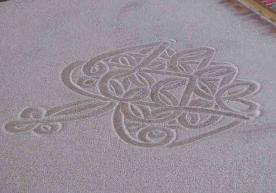
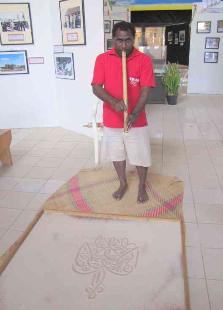
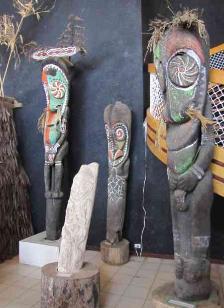
| Our docent, Edgar, is from the island of Espiritu Santo and drew the above designs while telling accompanying stories. He began as shown above and then never raising his finger, completed these intricate, beautiful designs. Drawings complete, he played a bamboo flute-like instrument and sang a traditional song in a low, quiet voice. A most fascinating demonstration makes us anxious to visit the islands where this art is still practiced. Far right, carved figures are made for tribal ceremonies . |
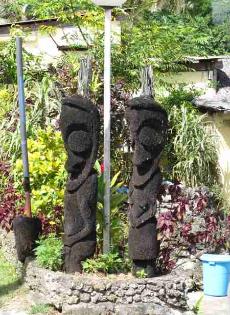
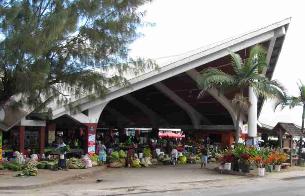
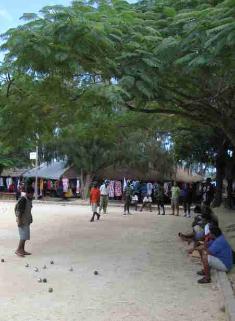
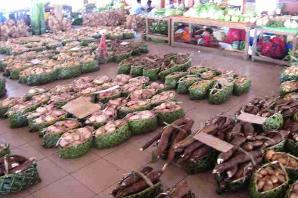
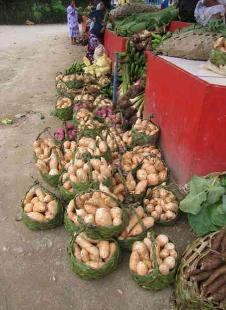
| Around town...from left, tree fern carvings are a familiar decoration throughout Port Vila; men play pétanque (like bocce ball) at the waterfront park; the outstanding fresh market spans the area between the main street in town and the waterfront and is open 24 hrs/day except Sunday. Fresh flowers, fruits and vegetables are all locally grown and we took advantage of the freshies. Green, woven pandanus palm baskets full of kumala (sweet potato) and bundles of taro for sale. |
| From Vila, we anchored in Havannah Harbour for one night en route to Epi. We planned on one long day's passage, but we were slower than anticipated and rather than risk arriving at night, we pulled into Revelieu Bay, about 10 miles shy of Lamen Bay, our planned destination. |
| Ai Creek, Havannah Harbour, Efate - 17S36.29 / 168E14.62 - 37' Revolieu Bay, Epi - 16S43.65 / 168E08.62 - 36' Lamen Bay, Epi - 16S35.72 /168E09.69 - 43' |
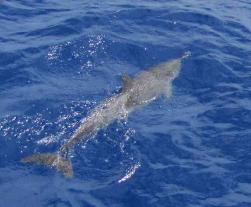
| En route to Epi, we were entertained by a large pod of bottlenose dolphins. |
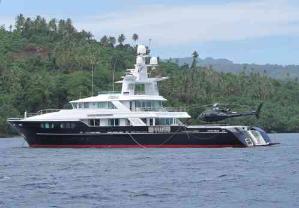
| We shared the anchorage with T6 which brought its passengers aboard via heliocopter. |
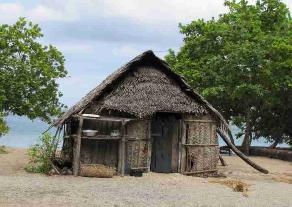
| A typical Epi village hut. Used only for sleeping, shelves in front hold baskets and basic cooking pots and utensils. |
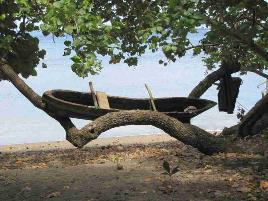
| High and dry, this dugout is stored in the crook of a tree. |
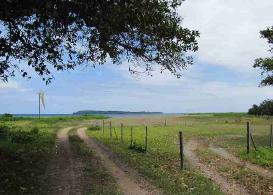
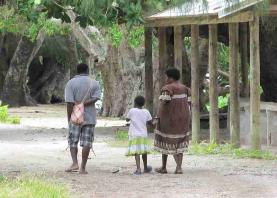
| The only indication that this field was Epi's airport was the wind sock that blew. |
| A family takes a stroll along the main street in Lamen Bay, Epi. |
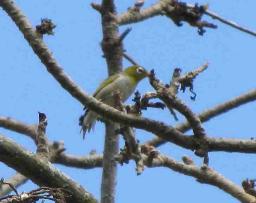
| Silvereyes are common on most islands. |
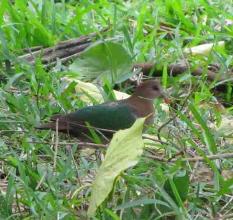
| An emerald dove |
| Ranon, Ambrym - 16S08.49 / 168E07.00 - 22' |
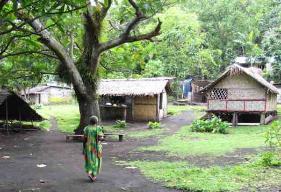
| Ambrym...the Black Island because of its twin active volcanoes, Mt. Marum and Mt. Benbow and hence its black volcanic soil. Or because it is the most mysterious island of Vanuatu with strong witchcraft, sorcery and traditions of magic? |
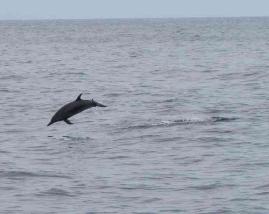
| We saw petite spinner dolphins as we rounded Ambrym's west coast. |
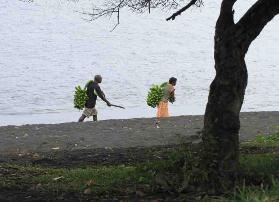
| A scene along Ambrym's black-brown volcanic sand beach which reminded us of used coffee grounds. |
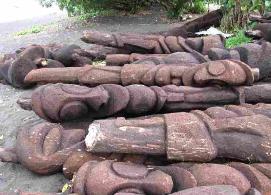
| Carved tree ferns or black palms lie in a heap on the beach getting ready for transport to Vila and Noumea. |
| Ranon village was neat and tidy with large well-walked pathways. We were welcome to wander and walk where ever we chose. |
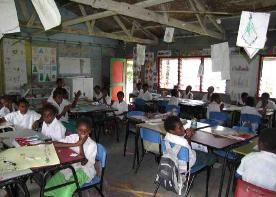
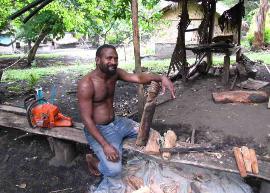
| We visited Grade 4 at the primary school and were treated to a class song. |
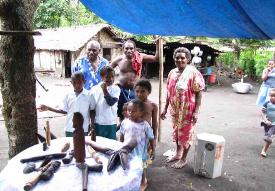
| Alex (blue shirt far left) is a carver and we bought one of his carved statues. His family joined him for this photo. |
| Ronnie, a carver, was our host in Ranon. He invited us for kava one afternoon and provided lots of fresh fruits and veggies. |
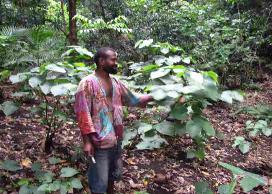
| Ronnie shows us a kava plant, a member of the pepper family, the roots of which are ground, mashed or chewed into a pulp. |
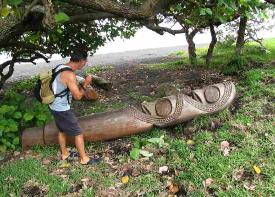
| Guillermo from "TinTin" gets a closer look at a tamtam (slit drum) on the shore. |
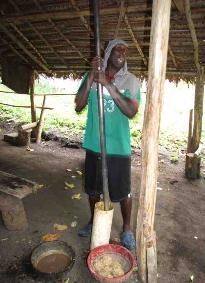
| Jeffrey crushes the kava root. The muddy looking water in the bowl to the left is kava. |
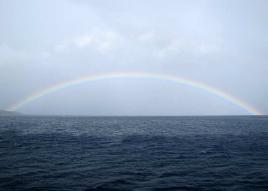
| The magic of Ambrym...a complete, bright rainbow stretches behind us after a morning shower. |
| Ronnie was articulate and openly offered information about Ambrym and its culture. At the nakamal (kava bar), we asked and he answered question after question. Yes, there really is strong magic on Ambrym ... many sorcerers practice both black and white magic. Too many unexplained, strange things have happened to ignore the power of these "men blong magik". |
| From Ambrym, we went west and south to the tiny Maskelyne Island group off the larger island of Malekula and anchored at Gaspard Bay for a night then made our way around the bottom of Malekula and up the west coast to calm, serene Southwest Bay where we stayed a week to do boat projects. |
| Gaspard Bay, Maskelyne Islands - 16S28.47 / 167E49.12 - 46' |
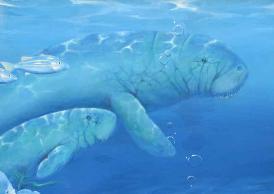
| We stayed one night only in Gaspard Bay with the hopes of seeing a dugong, a manatee-like critter and Vanuatu's only native marine mammal. We saw several, but never long enough for a photo. This mural in Luganville at least gives you some idea of what a dugong is. This is the same bay where Chief Jackson came aboard to show us some magic. |
| Dixon Reefs, Malekula - 16S21.29 / 168E23.02 - 36' |
| Excerpt from our blog: Jackson, chief of the local village, paddled up in his dugout canoe. He was quite the character. First, he welcomed us and then told us he usually charged 1000 Vatu for anchoring in the bay, but he'd take a bag of rice as a contribution to the village in lieu of the payment. He offered to teach us some of his tribal magic if we invited him aboard. How could we say no? Marcie was baking cookies and he waited patiently ... eating a half dozen warm cookies while waiting. As soon as she finished, the magic lessons would begin. He and David chatted amiably in the cockpit. When Marcie finally joined them, he described all the wonderful things he could do with his magic...heal the sick,calm storms, make rain or catch fish anytime he wanted to. In fact, we could tie him up and throw him overboard with a huge stone attached to him and he could just walk away unharmed. Normally, this knowledge is only passed from chief to first son, but it seemed it was okay to pass it on to yachties since we were leaving and not in competition with his tribe. He asked for a small cup of water and some "sampu"...hmmm? A sample? No, sampu! Ah, shampoo? Yes, sampu! Marcie was instructed to go below since she couldn't witness the strong magic that he was passing to David. The process included David removing all of his clothes, lying on the deck and Jackson murmuring incantations and rubbing David's body with the "sampu" and water. That phase completed, Jackson requested Marcie to remove all of her clothes and lie on the deck for the same ritual. "Oh, I don't think so." said David. "It's not our custom for other men to see our wives naked or have strange men, even chiefs, rub our wives' bodies with water and "sampu"." "Ah, yes, but I'm a chief, David, and it's okay to do this. Otherwise I can't transfer the magic and something bad might happen to your yacht." "We'll take our chances", countered David. "Perhaps, you can think strong, positive magic thoughts to keep our yacht safe.". "You should have told me before we started that your customs do not allow your wife to remove her clothes. It's very, very important to finish the transfer of the magic. Do not be afraid." Jackson was making a strong case for Marcie's nude participation. "I didn't realize that Marcie removing her clothes was part of the magic transferral. We're very sorry for the misunderstanding, but this is tabu. "I can keep the sampu?" "Certainly." Jackson ended his argument. With a bag of rice, 1/2 dozen more cookies, the rest of the sampu and one of Cups' old hatches in his dugout, he bid us farewell and paddled off to see a friend. |
| Southwest Bay, Malekula - 16S29.54 / 167E25.95 - 33' |
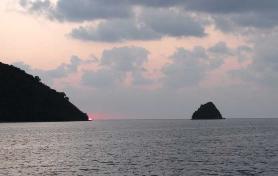
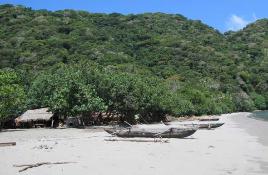
| We threaded our way through the narrow canals and reefs in the Maskelynes and had a great sail up the west coast of Malekula to Southwest Bay. Above a sunset with Ten Stick Island in the foreground. Rumor has it that American military during WWII paid 10 sticks of tobacco to be able to use the island for target practice. During WWII, up to 500,000 military personnel were stationed in Vanuatu, then known as the New Hebrides, as a base from which to fight the Japanese in the South Pacific. James Michener was stationed here and based his book, South Pacific, on this area. The imaginary Bali Hai is supposedly the island of Ambae seen at a misty sunrise from the island of Espiritu Santo. |
| Dugouts line the beach of Lembinwen Village. The villagers work harder here than anywhere else we've seen, paddling daily to tend their gardens inside the huge Tsiri Lagoon, the entrance of which is just beyond the beach above. |
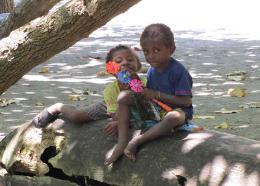
| Kids are shy, but curious and usually ferret out the fact that we have treats with us. This time it was banana muffins. |
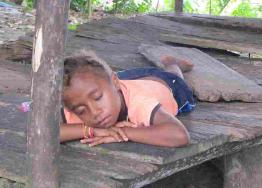
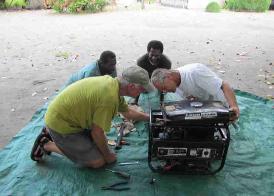
| Though she was quite interested in watching David repair a generator, she just couldn't keep her eyes open for the whole procedure. |
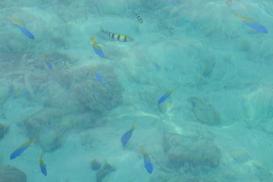
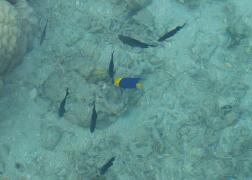
| These pictures do no justice to Dixon Reefs at all. Since we don't own an underwater camera (yet!), these were taken from the dinghy looking at the reef below. What you can't see is the glorious, healthy coral in different types, shapes and sizes and every color of the rainbow. The fish were wonderful. Big fish, little fish, blue fish, red fish... even sharks. |
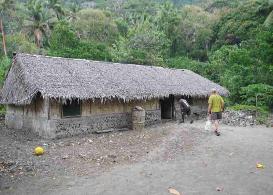
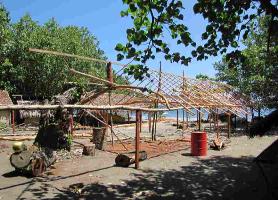
| The village is neat, tidy and growing. |
| We met Sailon and his family. Above, David follows Sailon into his house to begin works on solar panels. |
| A Swiss yachtie, Walter on Cinderella, joins David for a generator repair session. Folks queued up for the generator doctor. |
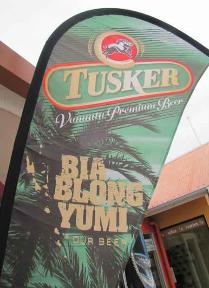
| A word about Bislama... Since over 100 languages are spoken in Vanuatu and each island in Vanuatu has at least one unique spoken language (Malekula has 23!!) which are not understood by neighboring islands and/or villages, a common language of Bislama (Bichelama) or Pidgin English developed. They speak it quickly and it's hard to follow, but we found reading it off signs and posters and then saying it out loud helped the comprehension process. Here's a sample: Wanem nem blong yu? What's your name? Nem blong mi is... My name is.... Yu save tok tok long Bislama? Do you speak Bislama? Sore, be mi no save tumas Bislama. Sorry, I don't know much Bislama. Please/Thank you (very much) Plis / Tangkiu (tumas) See you later, goodbye Lookim yu afta, tata Bia blong yumi (A Tusker beer advert) Our beer (see below) |
| Paradise Lodge Moorings -Aore Island, Santo -15S32.52 / 167E10.42 - Moored 122' |
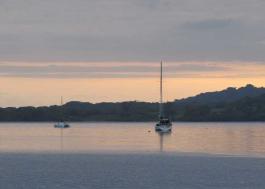
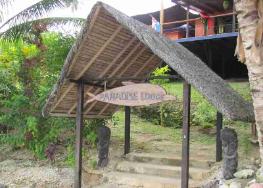
| We anticipated a stop between Dixon Reefs and Luganville, but the winds and current were with us and we flew.When we entered the Segond Channel, the water was calm as a mill pond. Across from our mooring was the "city" of Luganville and Espiritu Santo Island. |
| Alan & Debra Profke own and operate the Paradise Lodge. Aussies, they came here 6 years ago on a diving vacation and fell in love with the people and the place. They have seven moorings and a beautiful home. Alan is a physician and they operate a medical clinic for the locals. |
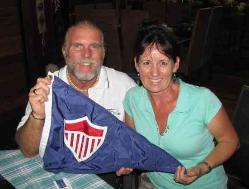
| Alan & Debbie had just become an Official SSCA Cruising Station and we had the privilege of presenting them with their SSCA burgee. This occasion called for a champagne toast and dinner at their home with Debbie and Ivan, their "crew" of f "Divine Wind". |
| A dinghy ride across the Segond Channel and we were in Luganville, Vanuatu's second largest (and only other) city. |
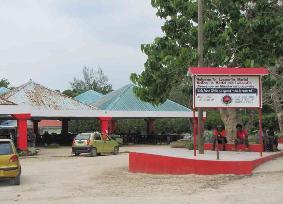
| We weren't in Luganville long. There's not much to see. All shops and services are along one main road. The fresh market (above and right) was good and LCM, the main supermarket, had a good selection, so we stocked up. |
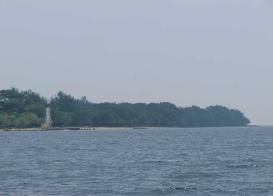
| From Luganville, we headed along Santo's east coast past Million Dollar Point (above) so named when the US Military deposited all its unneeded equipment in the sea when they departed at the end of WWII. |
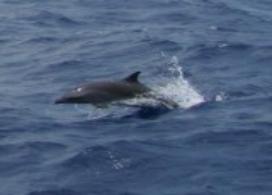
| Once again, frisky spinner dolphins accompanied us on our short passage north to Peterson Bay. |
| Peterson Bay, Oyster Island, Santo - 15S22.35 / 167E11.40 |
| Peterson Bay, tucked in behind an island and several reefs, is a hurricane hole. Entrance is tricky between the reefs, but once in and solidly anchored, we felt very few effects of the wind or sea and it was a perfect place to work on the boat. Besides being well-protected, it offered another substantial bonus: the Oyster Island Resort. Oyster Island offered free internet to cruisers. With our long range antenna, we were able to have internet (albeit painstakingly slow) on the boat. Besides internet, Oyster Bay also offered a nice restaurant, a bar with happy hour for cruisers, a beautiful, private 25 hectare island to explore with well marked footpaths throughout, reefs, snorkeling areas and secluded beaches. Between work days and projects, we managed to walk the paths and explore the island. More exciting however, was the proximity of the Nalaiafu River and its blue hole. |
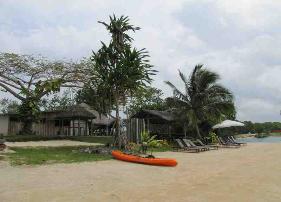
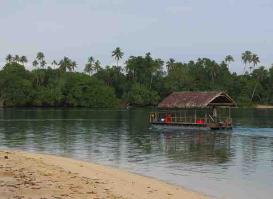
| Oyster Island Resort as seen from the anchorage |
| A neat thatched "palapa" boat provided transportation to the ferry dock on the other side of the bay for resort patrons. |
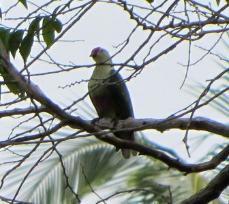
| Colorful fruit dove |
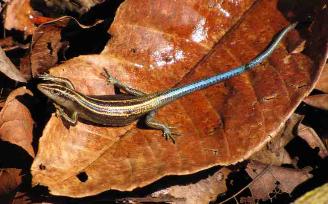
| Hundreds of whiptail lizards scurried in the underbrush after a morning shower |
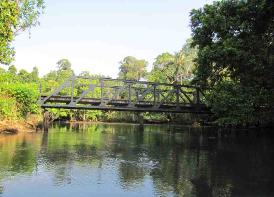
| A vehicle bridge crosses the Nalaiafu River. Traveling beneath it reinforced our fear of traveling on it. |
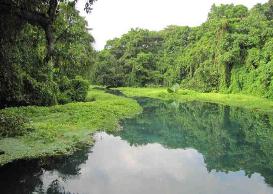
| The thickly reefed entrance to the Nalaiafu River gives way to a jungle-like setting and leads to a fresh water blue hole. |
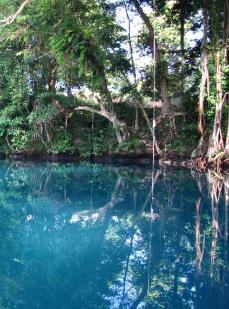
| Blue hole water is crystal clear, spring-fed, fresh water. It gets its blue hue from calcium carbonate deposits. |
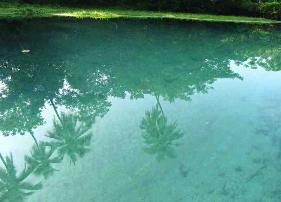
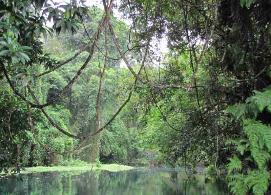
| The water is clear and calm and reflects the palm trees and vegetation above it. Colorful tropical fish swim lazily below as we dinghy its 3.5 km length. |
| We called this stretch "watercress alley". Yup, that's watercress fringing the sides of the river. |
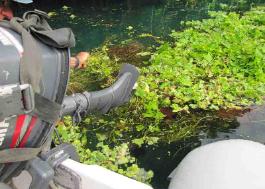
| The watercress was so thick in some areas and had overtaken the river that it fouled the prop on the dinghy engine trying to get through. |
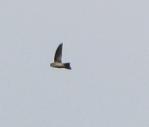
| Tiny swiftlets dart back and forth across the river swooping down for insects. |
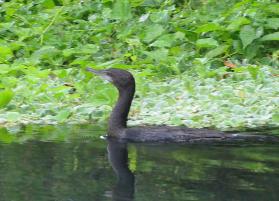
| A pair of little black cormorants seem to dominate the water birds in the area. |
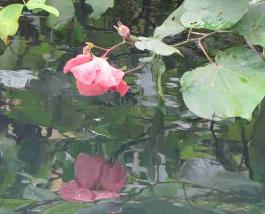
| Flora was as dominant as fauna. Above, delicate palau flowers reflect in the water. |
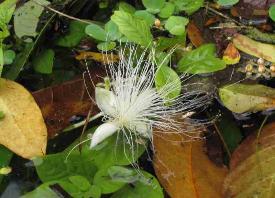
| Showy seedpods seem to explode as they float along the river waiting for a place to take root. |
| We received an interesting request from Marcie's sister, Lin, while we were anchored in Peterson Bay. It seems a co-worker's 6th grade son has read "Flat Stanley", a children's book by Jeff Brown, in class and is doing a world geography project based on it. Stanley is "flat" because he's gotten smushed by a bulletin board and is now like a proverbial pancake. He's fine otherwise, however, and can obviously be flat-pack mailed to and from anywhere in the world. The class is collecting info from as many places as possible. Lin sent directions via email and asked if we'd participate in the project. Why not? We remembered doing a presentation to our nephew, Nicks', 4th grade class many years ago. It was fun. We had to do a short description about where she was located, interesting info about the country or city, climate, etc. I have her perched in the salon on a shelf just above the settee and I found myself talking to her regularly. "Hey, Natu...how's it going?". She's quiet and doesn't eat much. She left us in Luganville, when like Flat Stanley, she was mailed to Marshfield, Massachusetts, USA to join her friends. Google "Flat Stanley" to learn more about this character. |
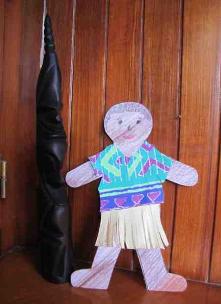
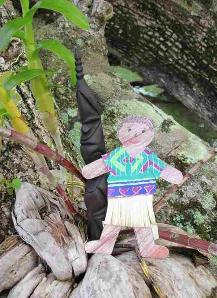
| I printed and cut-out a gingerbread-shaped figure that Lin provided. I could make the figure female or male so chose a girl and named her Natu from Vanuatu. Then I had to color her dark brown, draw in her hair and facial features and dress her like a paper doll...grass skirt and a colorful fabric blouse. |
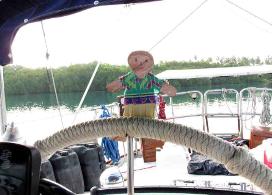
| We took Natu in the dinghy one morning to Oyster Island for a photo shoot. She was on the beach for one shot and sitting in a palm tree for another. She even took a turn at the helm. |
| Recommended reading: To Kill a Bird With Two Stones - Jeremy MacClancy - a good history of Vanuatu |